Surplus vs. Off-Spec: The Critical Difference in Industrial Procurement
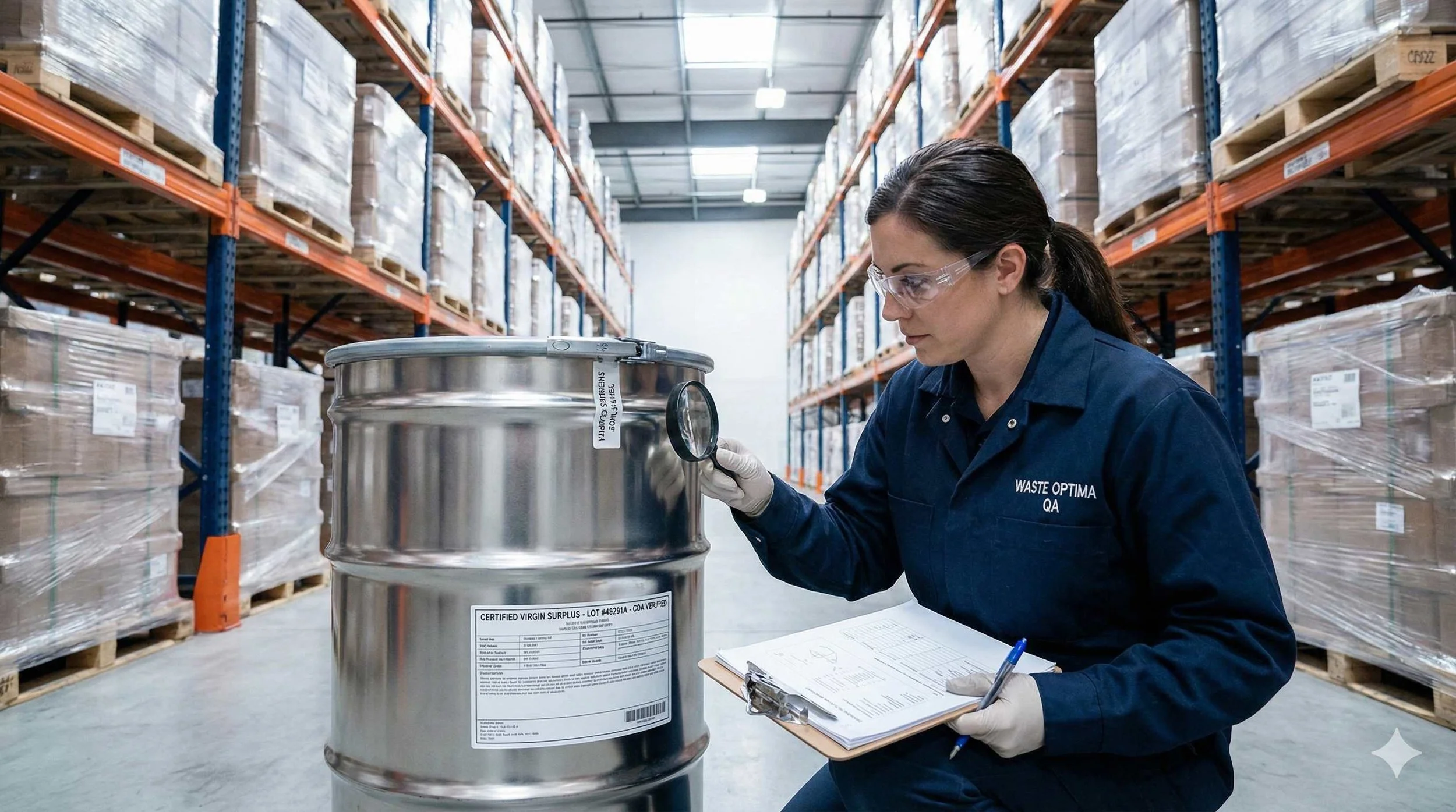
The industrial secondary market is often viewed as a "buyer beware" landscape. This perception costs manufacturers millions in missed savings. It’s time to demystify the difference between distressed logistics and distressed quality.
By Derek Michaelis | 5 Minute Read
Mention the "secondary market" to an industrial buyer or a Quality Assurance (QA) director, and you will likely see them wince.
Their hesitation is justified. For decades, the secondary market for chemicals and ingredients has been a Wild West of "mystery drums," reclaimed materials, and failed production batches disguised as deals. The prevailing wisdom in procurement is that buying surplus chemicals risks your entire production line to save a few cents on the dollar.
At Waste Optima, we agree: Buying unverified material is dangerous.
But there is a massive, critical distinction that smart procurement teams understand—the difference between Virgin Surplus and Off-Spec material.
Confusing these two categories is the primary reason manufacturers overpay for raw materials. One is a massive opportunity for margin expansion; the other is a liability.
Here is the definitive guide to knowing the difference, and why Waste Optima exclusively handles the former.
Stop Fearing the Secondary Market
Join the network that only deals in verified, virgin surplus with full COA documentation. Never question the quality of your inputs again.
Join the Preferred Buyers ListDefining "Off-Spec" (The Liability)
"Off-Spec" (Off-Specification) is exactly what it sounds like. It is material that was manufactured but failed to meet the producer’s rigorous quality control standards on one or more parameters.
Examples: A solvent where the water content is 0.5% too high; a polymer resin with slightly incorrect viscosity; a food ingredient that tested outside the acceptable color range.
The Risk: While some off-spec material can be "reworked" for less demanding applications (like industrial wash-down), it is fundamentally flawed. It does not match the standard Certificate of Analysis (COA) for that product grade. Using it in a precise formulation is a gamble that most QA managers will never take.
Waste Optima's Stance on Off-Spec: We do not source it for our manufacturing buyers.
Defining "Virgin Surplus" (The Opportunity)
Virgin Surplus is functionally identical to the material you buy from a primary distributor. It is perfectly good, first-run material that meets all original manufacturer specifications.
It is not "cheap" because it is flawed; it is discounted because it is logistically distressed.
Why does perfectly good material end up on the secondary market?
Over-Forecasting: A large manufacturer predicts they need 500 totes of Glycol for Q3 but only uses 300. The remaining 200 are taking up valuable warehouse space.
Packaging Changes: A brand switches its finished product bottle size, stranding thousands of gallons of an ingredient that is no longer needed for that specific SKU.
Short-Dating: Material is approaching the manufacturer's recommended re-test date, and major distributors won't accept it, even though it is perfectly stable.
The Reality: Virgin surplus is delivered in original, unopened manufacturer packaging with factory seals intact, accompanied by the original COA.
The Waste Optima Protocol: Trust but Verify
The biggest risk in buying surplus chemicals isn't the chemical itself; it's the lack of transparency from the seller.
Waste Optima was founded to act as the firewall between our buyers and low-quality inventory. We operate on a strict protocol to ensure that when you buy from our network, you are receiving production-ready inputs.
The Paper Trail: If there is no COA, there is no deal. We verify the paperwork matches the product before it is listed.
Seal Integrity: We deal almost exclusively in unopened containers. If a drum has been tapped, it is no longer "virgin surplus."
Transparency: If we ever offer material that is reclaimed or has a unique characteristic (like clumping in a hygroscopic powder), it is explicitly stated in the quote. There are no surprises at your loading dock.
Conclusion: Stop Fearing the Wrong Thing
Don't let the myth of "bad quality" keep you locked into paying full distributor pricing. The risk isn't in the material; it's in the vetting process.
By partnering with a network that knows the difference between a logistics problem and a quality problem, you can turn surplus sourcing into a safe, scalable competitive advantage.
We verify every lot.
Don't just take our word for it. See our rigorous quality standards and the types of verified inventory we carry.
Stop Fearing the Secondary Market
Join the network that only deals in verified, virgin surplus with full COA documentation. Never question the quality of your inputs again.
Join the Preferred Buyers ListFrequently Asked Questions About Surplus Quality
Q: What are the biggest risks of buying surplus chemicals? A: The primary risks of buying surplus chemicals are receiving "off-spec" material that doesn't meet formulation requirements, or receiving contaminated material due to broken seals. Waste Optima mitigates these risks by exclusively sourcing "virgin surplus" with original manufacturer seals and verifying COAs before listing.
Q: Does "surplus" mean the chemical is expired? A: No. "Surplus" refers to excess inventory quantity, not its age. While some surplus may be "short-dated" (nearing its re-test date), much of it has plenty of remaining shelf life. We clearly disclose all relevant dates on our quotes so your QA team can make an informed decision.
Q: How can I trust a COA from the secondary market? A: Waste Optima only provides the original Manufacturer's COA. We do not generate our own COAs or alter existing ones. This ensures the data you see comes directly from the lab that produced the material.